
Witch: Childhood Trauma, Unlocked!
This is one of the first books I remember making me cry. 40ish years later, I still got a little misty.
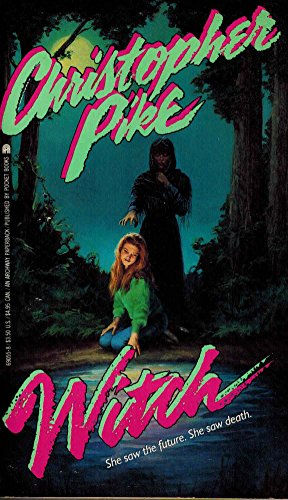
After finishing Spellbound, I was very excited to move on to Witch. I remember this book having a huge impact on me and really being devastated by the ending. Even though the overall experience wasn't quite as emotional as I remembered, I definitely got a little misty.
Julia is a witch. She can heal people with her touch, and she can travel to distant places when staring into a pond with sunlight shining on it. Her mother was a witch, but had recently died after her attempt to heal a young girl who had been injured in a motorcycle accident went terribly awry.
Her mother had warned her not to look at water with moonlight shining on it, and to be fair, she doesn't try to. She's inside a different vision, and in the vision she looks in and sees a boy she doesn't know get shot and die in her arms. Later that night, at a school football game, she meets this boy: it's her best friend Amy's new boyfriend, Jim.
So, in the vision Jim gets shot during a holdup of a liquor store. Obviously, that means that Julia's friends immediately plan to go to a liquor store after the game. Never mind that they are all high school students, they just can't stop talking about going to a liquor store. Julia talks them out of it, but then they decide to stop for gas at a gas station...that is also a liquor store. Because of course they do.
Julia convinces Jim to stay in the car, and sends her best friend in instead where he is the one who ends up getting capped in the dome. He survives and is taken to the hospital, but isn't expected to survive for very long. Julia is overcome with rage; the shooter is the man she saw in her vision, and the two have some unexplained hate that courses between them. I mean, he did just shoot her friend in the head, but this hatred seems to exist outside of their current situation.
Before we talk about the conclusion, I'm noticing something about Christopher Pike books that I don't remember from when I was reading them as a kid. First of all, everyone is super horny. I mentioned in the Spellbound review that, and I quote, "They be fucking." The boys in this book are just as much slaves to their hormones. There are several references to Scott recording the cheerleaders, and talking about all of the girls he wants to have sex with. He comes to the game with a waitress from a local coffeeshop that he lied to about his age, trying to get her into bed. When she figures it out, another one of the teens decides to shoot his shot as well (and partially succeeds). Randy, another of their friends, is always making sexual jokes, even at the most inappropriate moments. I know some people just have that kind of humor, but he's making jokes about wanting to see Amy naked when they are speeding to try to save Julia and Jim from a gunfight with the robbers. It's like they have no off switch. I can see having one character who behaves like this, but it's something that seems to affect all of the teen boys in these books.
There is also a kind of extremism to the situations that is different from the setups we see in something like the Fear Street books. Both authors create situations where teens have to face a variety of both natural and supernatural threats, and in both cases people die. But in Christopher Pike's books, the violence is much more graphic, and the situations more intense. When Julia confronts Frank, the hood who shot Scott, they have this epic gunfight in a liquor store. Julia shoots Frank's accomplice in the knee, and there are multiple paragraphs throughout the scene reminding us of exactly what happens when a knee is subjected to a shotgun blast. Frank and his friend (who is only 16) are drug dealers and avid meth smokers. The final confrontation ends up burning down this liquor store in the most dramatic (and almost unbelievable) way possible. It's action-packed, but it has an extremism to it that seems a little too wild for me in my adult brain. I'm sure teenage me, with my flair for the dramatic, ate that shit up with a spoon. And I'm sure that's the point.
Overall, the story is good, and the characters do have some nuance that makes them easy to root for, even when half of them are constantly talking about trying to bang some new chick. One thing that's strange is that Julia's mother has a sister (who has her own accomplices) that are set up as a sort of threat. They somehow know that Julia has looked into the moonlit water and they are angry; Julia makes vague references to them punishing her. They do show up at several points, but they are almost always a step or two behind Julia, and then at the end they show up and just...narrate what happened for the characters who were off the canvas? The threat of the aunt and her friends ends up being kind of a nothingburger, and in the end they aren't even particularly hostile.
But let's talk about what they were narrating. After the fiery confrontation at the liquor store, Julia takes her friend's car to go to the hospital. She knows that she can save Scott, but it will require her to sacrifice her own life. She manages to get into his cubicle in Intensive Care, and then there is an extended scene where she reconnects with her mother, and then speaks with Scott's spirit before she trades his lifeline for hers. When the others arrive at the hospital, they find previously comatose Scott miraculously healed and cradling Julia's head in his lap. She is dead.
While I enjoyed this book again, it definitely highlighted for me how much I've changed over the years. It seems like a dispatch from Captain Obvious to say that my reading tastes have changed over forty-odd years, but I think the change is more about what I respond to and how it affects me. I'm less drawn in by showy dramatics, and for an emotional hook to get me it has to have some real vulnerability behind it. While this was a good read, it doesn't pack the same emotional punch that I remembered it having when I was a hormonal teenager; the characters and their connections were not as meaningful. Maybe that's why we take a walk down Memory Lane, but we don't buy a house there.
PS: Another weird thing about Christopher Pike that has popped up in both of the books I've revisited: he has a weird way of presenting female friendships. Both Spellbound and Witch feature two female best friends who are described as one being gorgeous and attractive, and the other being plain or even homely. This dynamic, and how the boys around them react to them because of it, feels a little weird. He makes a point in Witch to mention that several of Amy's boyfriends have ended up asking out Julia...and Amy is weirdly kind of ok with it? After all, Amy could never compete in the looks department, so why wouldn't they? Very strange. In Spellbound, there is a bit more tension between Cindy and Pam around their interactions with the boys around them, but both still sort of accept that as the natural order of things. I'll be interested to see if that trope continues as I read more of his work. Maybe, deep down, he is the horny teenager he keeps writing into his books, and he can't imagine a female friendship that doesn't center on how they interact with and compete over potential male love interests?


Comments